


Naomi Haverland on Creating Motion Through Stillness
Updated: Sep 21

For Naomi Haverland, a still image does not have to feel still. Movement can exist in the way color shifts, the way light creates depth, and the way a viewer’s eye travels across a surface.
In Episode 9 of The Open Palette Podcast, Brian Camacho sits down with artist and muralist Naomi Haverland for a conversation about hyperrealism, visual storytelling, composition, emotion, and the technical decisions that make an image feel alive.
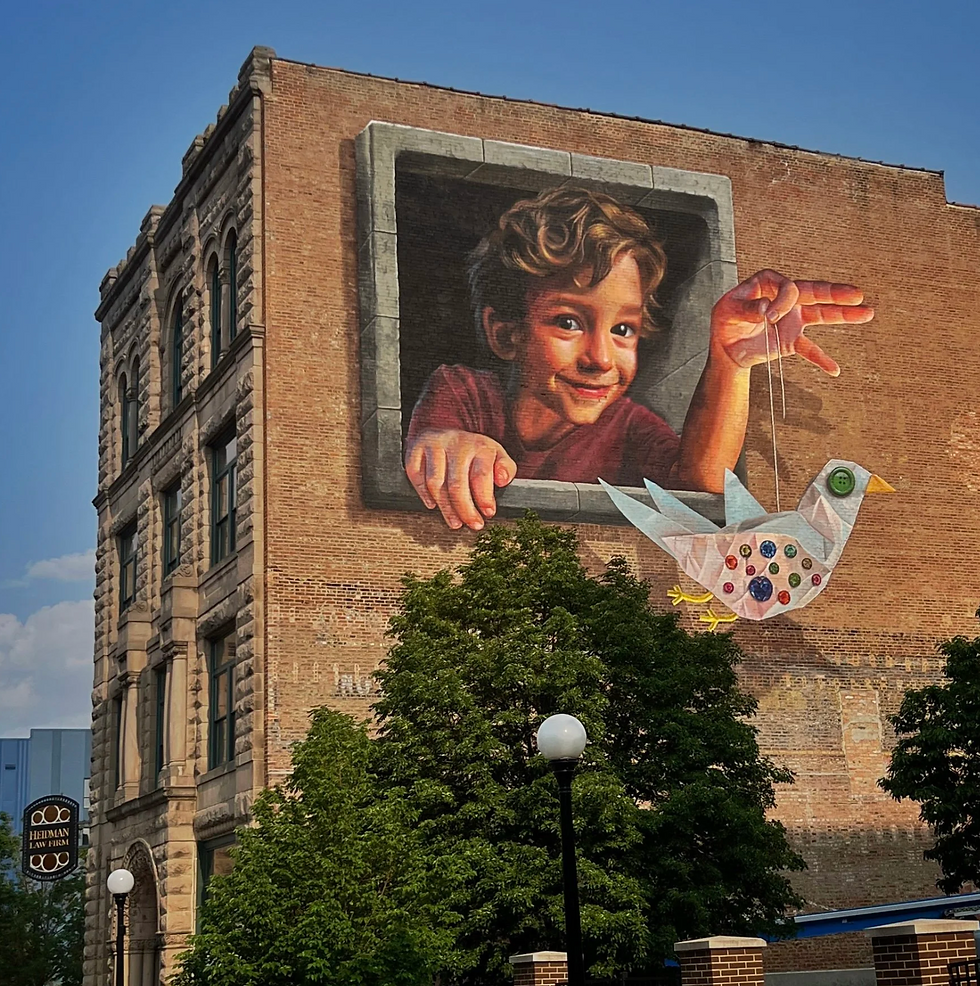
Haverland’s path began with residential murals, expanded into large-scale chalk work and anamorphic street art, and eventually developed into the mural practice she is known for today. What connects those forms is scale, illusion, and an interest in creating imagery that people do more than simply look at they react to it.
Her work is technically precise, but the conversation makes clear that realism alone is not the goal. Technique becomes most meaningful when it produces feeling.
Building From What Comes Naturally
Haverland describes her development as an artist with unusual simplicity: she kept doing more of what she knew she was good at.
Realistic textures came naturally. Positive reactions encouraged her to push that ability further. Repetition became refinement.
Rather than treating artistic development as a search for instant reinvention, Haverland’s experience suggests something more practical. Strength can become style when an artist gives it enough attention.
The process is cumulative. What begins as an instinct becomes a skill. What becomes a skill eventually becomes a recognizable visual language.
That does not mean ignoring weaknesses. Haverland openly acknowledges areas she does not consider her strongest. But instead of allowing those gaps to define the work, she has spent years sharpening the qualities that make her paintings unmistakably hers.
There is a lesson in that approach for developing artists: artistic identity does not always arrive through radical experimentation. Sometimes it emerges through sustained attention to what already feels authentic.
The Most Honest Reaction
Technical admiration can be rewarding. But for Haverland, one of the strongest indications that a piece has succeeded is much simpler.
A laugh.
While creating artwork live, she has experienced people approaching from behind, seeing the image, and responding instinctively.
“If someone laughs at my artwork, that’s the best feeling I can get.”
The significance of that response is not comedy itself. It is immediacy.
The viewer is not stopping to analyze lighting, rendering, perspective, or composition. They simply feel something.
For an artist whose work can easily be admired for its technical execution, that distinction matters. Hyperrealism naturally invites questions about skill: How did you paint that? How does it look three-dimensional? How is that surface so convincing?
But skill is not necessarily the final destination. Emotion is.
Haverland describes the laugh as proof that the work has moved beyond demonstration and entered communication.
Creating Movement Without Showing Motion
One of the most compelling ideas in the conversation is Haverland’s approach to movement.
Her paintings are physically still, yet they often feel dynamic.
That effect begins long before she touches the wall. Haverland spends significant time developing the composition in advance, testing designs at small scale and studying how the image will function when viewed from a distance.
Once painting begins, much of the improvisation has already happened.
The movement she is looking for is not necessarily an image of someone running, jumping, or turning. It is the movement of the viewer.
“I’m wanting your eyes to move around the piece.”
Color, value, texture, contrast, and composition become a kind of visual choreography.
A viewer enters the painting in one place. Something pulls them toward another. A shift in value redirects attention. A texture slows the eye down. A color relationship sends it somewhere else.
The mural is still. The experience is not.

That distinction is central to understanding Haverland’s work. Motion can be created without illustrating action because the true movement is happening inside the act of looking.
Precision Without Becoming a Machine
Hyperrealism creates an unusual problem. The better an artist becomes at realism, the easier it can become for technical perfection to overwhelm artistic expression.
Haverland is aware of that tension.
She describes getting pulled deeply into rendering and perfecting realistic detail, sometimes at the expense of emotion.
Her response has been intentional: leave evidence of the painting. Leave brushstrokes. Allow colors to visibly mix. Let the material remain visible rather than hiding every trace of the artist’s hand.
“I’m very intentional about trying to combat just becoming a Xerox machine.”
That statement exposes an important divide between reproduction and interpretation.
If technical realism becomes the only measure of success, painting risks becoming a competition with photography.
Haverland is looking for something else. The realism establishes belief. The brushwork establishes presence.
That balance allows the viewer to understand both what is being represented and the fact that a human being made it. For Haverland, emotion enters through that space.
The Illusion of Depth
When people encounter Haverland’s large-scale work, one of the most common questions is also one of the simplest: How did you do that?
Her answer reveals that some of the most dramatic effects in visual art are built from surprisingly fundamental principles.
One of her favorite tools is the cast shadow.
A properly placed shadow can immediately suggest that an object is lifting away from the wall.
Add perspective, atmospheric depth, sharper foreground details, softer backgrounds, controlled lighting, and changes in color temperature, and a flat surface begins creating the illusion of space.
None of those devices are mysterious on their own. Their strength comes from accumulation.
The illusion works because the viewer’s brain recognizes visual information it already understands from the physical world. Light behaves a certain way. Distance behaves a certain way. Edges behave differently depending on where something sits in space.
Hyperrealism becomes convincing when those relationships feel believable enough that the viewer temporarily forgets the surface is flat.
What Chalk Teaches About Impermanence
Haverland’s background in chalk art gives her an especially relaxed relationship with permanence.

Chalk work is temporary by nature. Weather arrives. People walk across it. The image disappears.
For Haverland, that experience made impermanence part of the artistic process rather than something to fear.
“I feel like all art is impermanent. Nothing’s going to last forever.”
The mural may remain longer than chalk. A painting may survive longer than a mural. But eventually, every physical artwork changes.
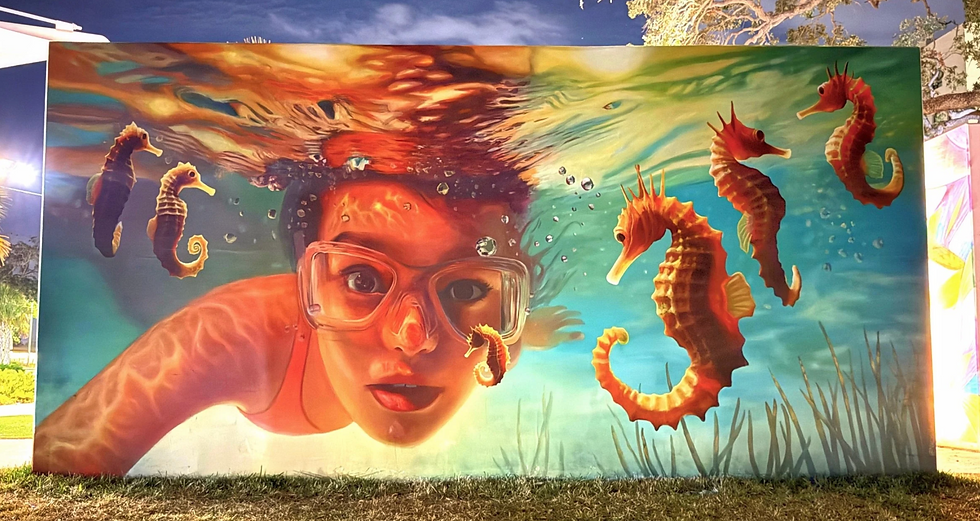
Haverland points toward the digital image as another kind of archive. A physical work may disappear while its photograph continues circulating online.
There is an interesting shift there. The artwork once depended on the material object for survival. Today, an artwork can disappear physically while continuing to exist culturally through documentation.
The temporary object becomes part of a permanent digital footprint.
Learning to See Differently
Years spent studying realism inevitably change the way an artist sees ordinary life.
Haverland describes constantly noticing lighting and texture.
Even during conversation, she finds herself thinking about how she might paint the light falling across someone’s face.
This type of observation is one of the hidden disciplines behind realism. The artist is continuously translating reality.
How soft is the light? Where does the edge disappear? What color actually exists inside the shadow? How does texture change across distance?
The world becomes a continuous study.
But Haverland connects that practice to something beyond visual analysis. It has also reinforced humility.
There are people who look at her work and consider her a master. At the same time, she sees artists whose abilities seem far beyond her own.
And those artists are probably looking toward someone else.
No one occupies the final level. Every artist remains a student of another artist. That perspective keeps mastery from becoming a destination.
A Bouquet of Images
Toward the end of the conversation, Haverland offers perhaps the clearest metaphor for understanding her work.
She does not necessarily approach every mural with a social message, political argument, or philosophical thesis.
She wants people to experience something beautiful.
She compares herself to a florist. Colors and images become the flowers. The mural becomes the arrangement.
“A mural is like a bouquet of images that I’ve put together.”
Nobody looks at a bouquet and demands that it explain itself.
Sometimes beauty is enough.
That position is more meaningful than it might initially appear.
Contemporary art is often expected to justify itself intellectually. Artists can feel pressure to attach increasingly complex language to work that may have begun from intuition, humor, visual pleasure, or curiosity.
Haverland allows the visual experience to stand on its own.
Her primary language is beauty. Her desired response is joy. And sometimes the most direct relationship between artist and viewer begins there.
The Takeaway
Movement does not require motion. A still image can guide the eye, shift emotion, create illusion, and transform the way someone experiences a space.
Naomi Haverland’s practice shows how technical skill becomes most powerful when it stops being the subject of the artwork and starts serving the experience.
The shadows matter. The perspective matters. The composition matters. The hours spent designing before painting matter.
But ultimately, those decisions exist to create a feeling.
A viewer stops. Their eyes move across the wall. Something feels real. Maybe they smile. Maybe they laugh.
For a moment, the painting is no longer still.
Continue Your Creative Journey
Explore Artist Opportunities: Discover current grants, residencies, mural calls, fellowships, and public art opportunities curated by Open Palette.
Next in Open Palette Insights: Episode 10.
The Open Palette Podcast | Where art, culture, and community come together through real conversations.

Comments