


Nico: Protecting Your Peace, Finding Your Voice, and Creating with Purpose

Updated: Oct 1

For Nico, becoming an artist has also meant learning how to become more fully herself.
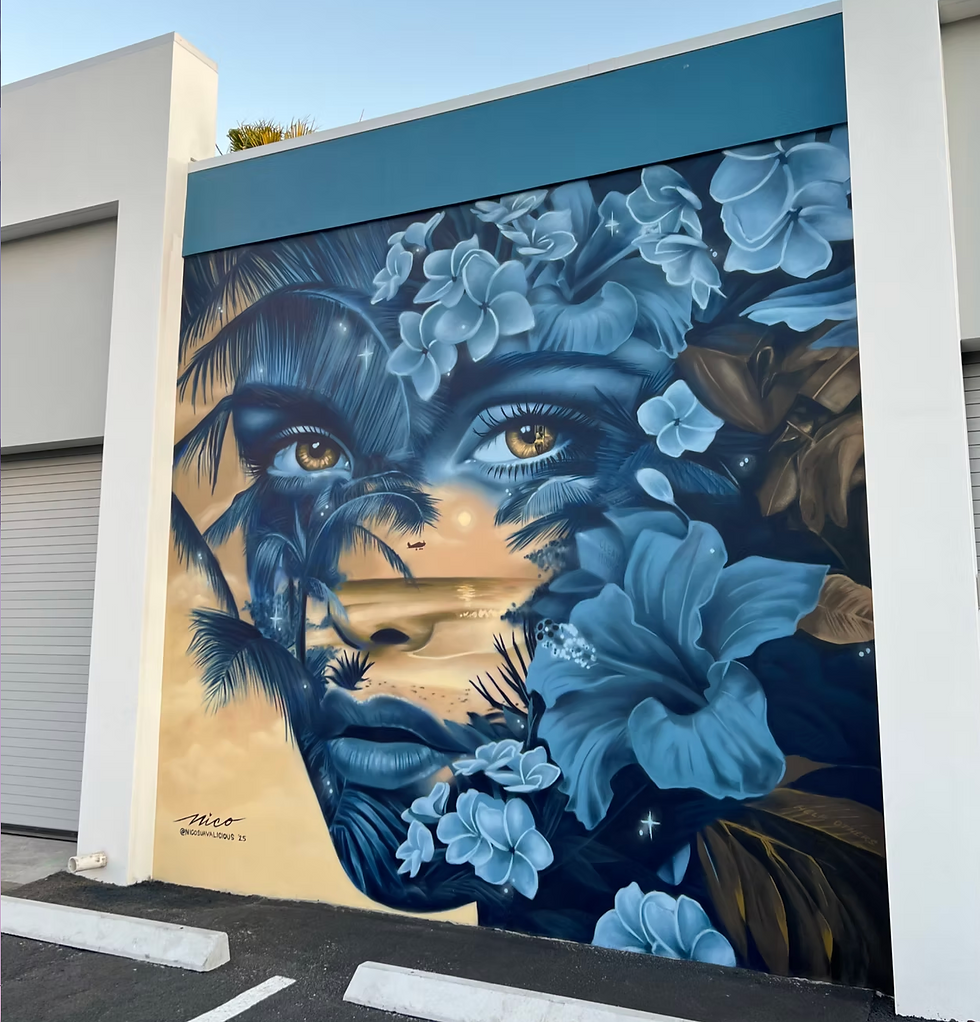
Her work is filled with nature, animals, dreamlike symbolism, strength, softness, and the unmistakable atmosphere of Florida. But underneath those visual elements is something more personal: an ongoing search for balance.
Balance between giving and preserving. Between opportunity and purpose. Between creating what others need and creating what she needs to say.
And perhaps most importantly, between building a career and protecting the person responsible for creating the work in the first place.
Nico's journey is not simply about developing an artistic style. It is about recognizing that artistic growth often requires personal growth alongside it.
Florida as a Visual Language
Born and raised in Florida, Nico speaks about the state's landscape almost as if it were another character within her work.
The sunsets - The water - The beaches - The birds - The animals - The Intracoastal
These are not simply decorative references. They are part of the environment that shaped the way she sees.
Her fascination with Florida's natural beauty eventually became a way of communicating ideas larger than the landscape itself. By bringing those elements into her paintings and murals, she can celebrate the place she comes from while encouraging people to recognize the value of preserving it.
Nature becomes both subject and language.
A bird can represent more than a bird. An animal can become a guardian. A landscape can become a space for discussing peace, reflection, spirituality, or the emotional experiences unfolding within her own life.
The imagery may be beautiful, but beauty is rarely the final destination. Nico uses it as an entry point into something deeper.
When Community Changes the Artist
Long before Nico became focused on establishing a recognizable personal visual language, much of her energy was directed toward community.
That work began in Jacksonville.
After developing an idea for a children's mural festival, Nico entered the project into a crowdfunding festival. She did not win. But becoming a finalist placed the idea in front of the Jacksonville Parks and Recreation Department.
They saw potential in it.
Soon, Nico was bringing temporary mural walls into community centers located in some of Jacksonville's most underserved neighborhoods.
What began as an art project quickly became something much more significant.
Working directly with children who had little exposure to murals, painting, or organized arts programming changed the way Nico understood what art could accomplish. She began thinking beyond the children who could attend an event and toward the children who could not.
Transportation was a barrier. Access was a barrier. Awareness itself was a barrier.
So instead of waiting for those communities to come to the art, she began finding ways to bring the art directly to them.
Through grant-supported programming, that mission eventually reached approximately 35 schools in about a year.
The lesson was bigger than murals.
Art could introduce possibility.
At a time when Nico was witnessing violence affecting communities around Jacksonville, she wanted young people to understand that creativity could represent another path. One rooted in expression, connection, and peaceful ways of imagining a future.
But giving continuously comes with its own consequences.
Eventually, Nico reached a realization familiar to many people working within community-centered creative spaces: You cannot continue pouring from an empty cup.
Building the Foundation Before Giving Again
Community work remained important to Nico, but sustaining that work became increasingly difficult when the resources supporting it disappeared.
There came a point when the artist trying to help everyone else also had to recognize what she herself needed.
That realization contributed to her decision to move to Miami and place greater focus on establishing her own career.
It was not a rejection of community. It was an understanding that impact requires infrastructure.
If Nico wanted to continue giving, she first needed to build something stable enough to give from.
That distinction matters.
Artists are often encouraged to sacrifice endlessly for their communities, their careers, their opportunities, and even their visibility. But sustainability asks a different question: What foundation are you building beneath everything you are giving away?
For Nico, establishing herself professionally became part of preparing for the next version of her contribution.
Creating an Identity That Belongs to You
As Nico's career evolved, another question began emerging: What does her artwork look like when no one else is deciding what she should paint?
Years of commissions and community projects taught her how to execute ideas for other people. But technical ability and artistic identity are not necessarily the same thing.
Finding that identity required experimentation.
One recurring image became the Doberman.

The attraction was initially visual. Nico saw something powerful in the animals beauty and aggression existing simultaneously. Masculine and feminine energy. Protection and elegance. Strength without sacrificing grace.
Audiences responded strongly to the imagery.
Instead of allowing that response to remain purely aesthetic, Nico developed the idea further.
The dogs became her Spirit Guide Guard Dogs.
Each exists not only as an image but as a symbolic protector carrying a specific message or purpose.
One, The Spirit of Self-Reflection, centers on the idea that examining ourselves is essential to creating balance. The piece asks the viewer to pay attention to what they are carrying internally and what they are projecting outward into the world.

That transformation from painting something because it looks powerful to understanding why it belongs within your visual vocabulary is an important stage in the development of an artist.
Style becomes stronger when imagery stops being decoration and starts becoming language.

Protecting Your Peace Is Part of the Practice
Artists frequently discuss what they need in order to create.
More time. More money. More space. More opportunities.
Nico has increasingly become interested in another resource: Energy.
For her, protecting that energy has become an everyday practice.
She speaks openly about examining the things in her life that consume time, energy, or peace and making deliberate decisions about what deserves to remain.
That process has included stepping away from drinking, exercising, practicing hot yoga and Pilates, walking, becoming more conscious of what she consumes, spending time in nature, and journaling as a way of processing her experiences.
None of these things exist separately from the artwork. They support it.
There is a tendency to romanticize the exhausted artist. The person sacrificing sleep, health, relationships, and stability in pursuit of the work.
Nico's perspective pushes against that mythology.
What happens when taking care of yourself becomes part of taking care of the work?
What happens when peace becomes something an artist actively protects rather than something they hope to find after everything else is finished?
For Nico, peace does not mean the absence of difficulty. It means learning how to remain grounded inside it.
If we can find a way to have peace in the midst of chaos… that is what is going to set us up for success.
That philosophy appears both inside her life and inside the work she creates.
The Business of Making Your Own Art
Finding peace does not eliminate the practical realities of being a working artist.
Nico has access to something many artists dream about: a dedicated studio space where she can develop new work.
But walking into a studio does not necessarily mean spending the entire day painting.
There are emails. Design work. Administration. Bills. Commissions. Projects that pay well but may not represent the artist's personal vision.
That tension sits at the center of professional creative life.
A mural for a major brand may represent an important career achievement. It can provide income, visibility, and another recognizable name for the portfolio.
But Nico recognizes the distinction clearly.
Executing someone else's design is not the same experience as building your own world.
The challenge now is figuring out how to reduce the amount of energy required simply to survive so that more of that energy can be invested in her own concepts, imagery, and ideas.
That goal represents another stage of artistic independence.
The question is no longer simply: Can I make a living with my creativity?
It becomes: Can I build enough value around my own artistic voice that my creativity does not always have to belong to someone else?
Becoming the Next Version of Yourself
Near the end of the conversation, Nico makes what appears to be a small comment about her name.
She has considered simplifying it. Changing it. Evolving it. Becoming, in her words, more elegant.
It is a fitting conclusion because the conversation itself is ultimately about evolution.
The artist who once concentrated heavily on fulfilling commissions is increasingly interested in defining her own visual identity.
The community organizer who once poured nearly everything into serving others has learned that she must also create a foundation for herself.
The imagery she once painted because it was visually compelling has developed into a symbolic language carrying ideas about protection, duality, reflection, and balance.
And the person behind all of it has become increasingly intentional about deciding what receives access to her time, energy, and peace.
Artists are often told that growth means producing more.
More paintings. More murals. More clients. More recognition.
Nico's journey suggests another possibility.
Sometimes growth is subtraction.
Removing what drains you. Stepping away from identities you have outgrown. Saying no to opportunities that move you further away from your own work. Creating boundaries around the life that makes creativity possible.
And becoming increasingly comfortable with the idea that protecting your peace is not separate from becoming a stronger artist.
It may be one of the most important parts of the work.
The Takeaway
Protecting your peace is not separate from the creative process. It is part of the structure that allows the work to continue.
Nico's journey shows that artistic growth can require boundaries, self-reflection, and the courage to make more of the work that genuinely belongs to you.
Community, career, identity, and personal well-being do not have to compete with one another, but sustaining them requires intention.
The studio matters. The commissions matter. The opportunities matter. But so does the life surrounding the work.
Sometimes growth is not about producing more. It is about becoming more selective about what receives your energy.
When an artist protects that foundation, the voice inside the work has more room to become clear.
Continue Your Creative Journey
Explore Artist Opportunities: Discover current grants, residencies, mural calls, fellowships, and public art opportunities curated by Open Palette.
Next in Open Palette Insights: Episode 11.
The Open Palette Podcast | Where art, culture, and community come together through real conversations.

Comments